
×

    Warning

    JUser: :_load: Unable to load user with ID: 62

    Salvation Army band in Yogya

    Yogya Band


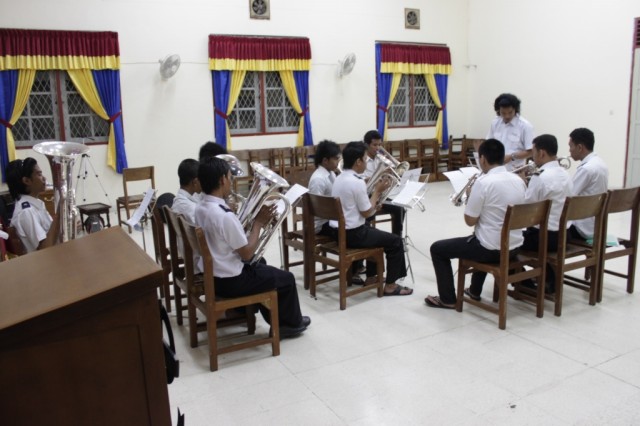
    Yogyakarta (Yogya), long renowned as a centre of classical Javanese fine art and culture, now has a Salvation Army band!

    The 13-member ensemble is being taught by BBJ tuba player Lasnointer Marbun.

    Yogyakarta (Yogya), long renowned as a centre of classical Javanese fine art and culture, now has a Salvation Army band!

    The 13-member band based at the Yogya corps practices twice a week (Thursdays 7-9pm and Saturdays 8-9.30pm) and is being taught by BBJ tuba player Lasnointer Marbun.

    Regular visitors to this website will remember that Lasnointer (Noin to his friends) is currently studying music at Yogya's Indonesian Institute of Fine Arts (ISI) after his lack of fluency in English forced him to abandon plans to study at Singapore's Nanyang Academy of Fine Arts. Noin's living expenses and university fees are being paid for by a sponsor in Singapore. The band was formed in September 2011, just two months after Noin arrived in Yogyakarta to begin his course at ISI.

    Yogya, a city of about 500,000 people, is one of the most popular tourist destinations on Java.  It is also the capital city of the province of the Yogyakarta Special Region, located in the southern part of Central Java.

    There were no brass instruments at the corps, or course, so we established a system in which I would bring second-hand instruments with me each time I visited Jakarta to research stories for my newspaper. Noin would then make the 9-hour train journey to Jakarta to meet me and collect them.

    The current instrumentation of the band is as follows: Four cornets, three alto horns, three baritones (actually euphoniums), two trombones and one E-flat tuba. Seven of the learners are corps (church) members, while five others are teenage residents of the Salvation Army's boys home in the city. Efan, a trombone player and one of Noin's fellow students at ISI, sometimes helps him teach the band.

    Here is a photograph of part of the cornet section:
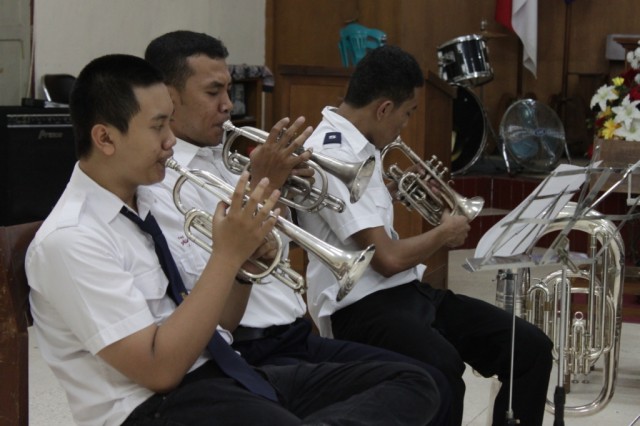
    Yogya Band Cornet Section

    Music stands are in short supply. But I will be carrying several with me when I meet Noin in Jakarta during August. The band could also do with another E-flat tuba (B-flat tubas are too expensive for my budget), but we hope to remedy that problem sometime next year (2012).

    Here is part of the lower brasses:
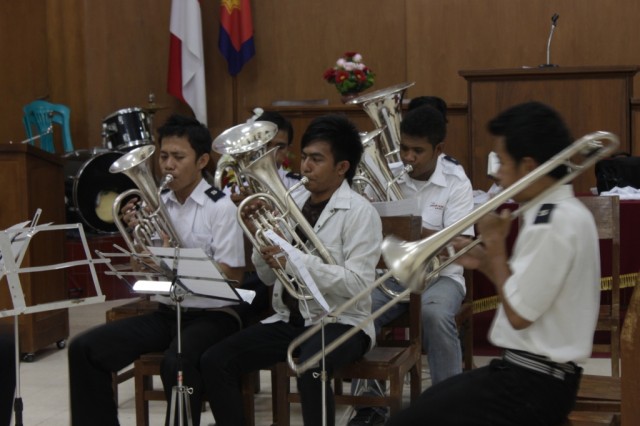
    Yogya Band - lower brasses

    The band had its first public performance two months ago when it played at a church youth meeting.

    The repertoire of the Yogya band is still very limited, but Noin reports that they can play "Whisper a Prayer" as well as several tunes from the Salvation Army's band tune book, including numbers 199 (Anything for Jesus) and 16 (Deep Harmony).

    The formation of the Yogya band follows the establishment of a band at the Salvation Army Boys Home in Bali in late 2010.

    BBJ is no longer the only functioning Salvation Army band in Indonesia. Long may it remain so!

    Additional photographs of the Yogya band will be available in the BBJ photo gallery in the coming weeks.


    Latest Focus

    A Dream Fulfilled

    A poor but talented Indonesian E-flat tuba player who wants to study music in Singapore's prestigious Nanyang Academy of Fine Arts (NAFA), is very close to realising his dream.

    An impossible dream?

    When Joe Darion wrote the lyrics to the famous melody written by Mitch Leigh for the 1965 hit musical Man of La Mancha, I don't suppose he spent much time thinking about the ambitions of E flat tuba players.

    Are musicians more moody and prone to suicide than other people?


    Many people believe that musicians are more moody and prone to suicide than other professionals, and that - as a result - a greater percentage of them end their lives in mental institutions or are fated to live emotionally tempestuous lives. Musicians are also commonly suspected of being over sensitive to criticism, having delusions of grandeur and other neurotic traits.

    The statistics fail to bear this out, although it is possible to find enough examples to make the case in front of those unfamiliar with Western musical history. Like actors, politicians and others obliged to face the public on a regular basis, musicians probably have their fair share of emotional problems. However, such problems do not constitute evidence of neuroticism.

     Musicians probably have their fair share of emotional problems. 

    Beethoven was known for his moodiness, but this was probably closely related to his growing frustration as he began to go deaf. Among the famous composers, only Schumann and MacDowell ended  up in mental institutions. Musicians probably have no more suicidal impulses than the rest of the population. But should a prominent musician decide to take his life, it is likely to get a good deal of publicity.

    Perhaps the most morbid suicide was planned by the pianist Alexander Kelberine, who arranged his last concert programme to consist only of works dealing with death. He then went home and took an overdose of sleeping pills. Schumann jumped into the Rhine, only to be rescued by a fisherman. Rezso Seress composed Gloomy Sunday, a work that was once banned in Europe because it triggered a wave of suicides by young people on Sundays. Seress himself committed suicide by jumping out of a window. The vast majority of musicians, however, die of causes that reflect the state of medical knowledge in the particular historical period in which they live.

    Some musicians certainly had sad lives. Mozart, perhaps the greatest of the composers in the Classical Period of music, died a pauper. The pianist Chopin, a Polish nationalist and tormented lover, was terrified of large audiences. He died of tuberculosis when he was 39. Bizet, a French composer who died when he was 36, was beset by crises of self-confidence and emotional upheaval. Unlike Chopin, his works only achieved widespread recognition after his death.

     Wagner had the emotional maturity of a spoilt child. 

    George Gershwin only had a short life, but it was a good one. He died of a brain tumor when he was 39 after a rags to riches story that made him one of the most well known composers of popular music in  the United States.

    Others lived long and had much success, despite treating others abominably, including many of their friends. Wagner considered himself a genius as a playwright, poet, stage director, and philosopher as well as a composer, and was not shy about letting others know it! Although not particularly handsome, his personal magnetism was such that he had numerous affairs, usually with married women, despite the fact that he was married himself. His biographers describe him as having the emotional maturity of a spoilt child, complete with tantrums if he could not get his way. He died at the age of 70, widely acclaimed as one of the greatest composers of his time.

    The pianist Franz Liszt's dashing good looks enabled him to have numerous affairs with many woman. He died of pneumonia at the age of 75. Contrast this with the fate of Schubert, who was short, fat, bespectacled and naturally shy. He died of syphilis at the age of 31 after his friends encouraged him to visit a brothel. Those who knew him well described him as having a warm and friendly nature. Somehow, it doesn't sound fair.

     The life of J.S. Bach must have been very boring. 

    The majority of musicians now and in the past lead fairly quiet lives. Edward Elgar, a largely self-taught musician, rose from humble origins to become the first English composer in 200 years to gain international acclaim. He had a stable marriage, and was regarded by many as a typical English gentleman. He died at the age of 77. Sergei Rachmaninov, the Russian composer, also had a good life despite being out of step with his country's politics and music. He died at the age of 70.

    The life of J.S. Bach must have been the most boring of all. He spent almost his entire life in the same small region of Germany where he was born. And nobody took much notice of him either. It was not until about 80 years after his death that his works attracted the attention they deserved.


    Concert Nerves

    In his book Random Reflections, the late English classical composer and pedagogue William Lovelock recalls an occasion where he was called upon to examine music candidates at a school.

    Hitting the Right Notes

    FOR a country of 240 million people, Indonesia’s Western music scene is surprisingly low key. There are only two well-established symphony orchestras, well-designed auditoriums are rare, and few Western-trained musicians can find enough work to make a decent living.

    Latest Video

    Category: BBJ
    Views: 24

    Category: BBJ
    Views: 6

    Category: BBJ
    Views: 1

    Category: BBJ
    Views: 0

    Category: BBJ
    Views: 1

    Category: BBJ
    Views: 2

    Category: BBJ
    Views: 1

    Category: BBJ
    Views: 5

    Category: BBJ
    Views: 1

    Category: BBJ
    Views: 4

    Category: BBJ
    Views: 7

    Category: BBJ
    Views: 7
    © 2026 Your Company. All Rights Reserved. Designed By JoomShaper

    Please publish modules in offcanvas position.