
Wind instruments produce sounds by means of a vibrating column of air in much the same way as a vibrating string on a guitar or piano.
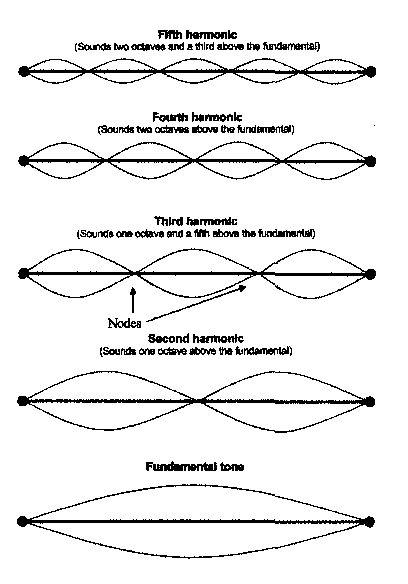
In mathematical terms we may say that the frequency of each harmonic is in inverse proportion to the size of the fraction. This means that the vibration of equal halves of a string produces double the frequency of the whole (and thus sounds an octave higher), the vibration of equal thirds triples the frequency (and therefore sounds an octave and a fifth higher than the fundamental note) and so on. The range of notes so produced is called the harmonic series.
The above physical laws have great significance for musicians in general and wind band players in particular. Whether he understands the implications of the harmonic series or not, every brass player takes full advantage of this basic physical law when he uses the same fingering to produce notes of different pitches. This is done by adjusting his embouchure in such a way that it favours different partials of the same fundamental tone.
Other wind instruments have either cone-shaped bores [the diameter gradually widens] or at least enough conical tubing to cause them to act acoustically as open pipes and thus get the same harmonics as a guitar or piano string. While this cone-shaped bore is easy to see in the case of tapered sections of brass instruments, it can be less obvious in the case of some woodwinds. It is not often realised, for example, that the flute has a conical headjoint


