
Scales

    Ascale constructed using only the notes found in the harmonic series is called a scale of 'just intonation'. Unfortunately, musical instruments built around such a scale are only able to play music in one or two keys.  This is because the intervals produced by the upper partials are not equally spaced within the octave.  Some notes therefore sound out of tune when the instrument is used to play in more remote keys.  

    Piano tuning is based on a series of compromises.
    Since the time of Bach, the scale of just intonation has therefore been replaced by one of “equal temperament” in which an octave is divided into twelve equal intervals. On a piano, this means that notes such as B-flat and A-sharp are identical despite the fact that in terms of the laws of physics they actually differ slightly.  Professional singers and wind players have an advantage here.  By listening carefully and using their embouchures or vocal chords to make the tiny adjustments that may be necessary when playing or singing in different keys, they can come much closer to the natural intonation than is possible on a modern keyboard.

    In practice, no instrument can produce all the notes of the harmonic series.  This is so irrespective of the ability of the player. A trumpeter, for example, is not normally expected to play a concert B-flat on the second space of the bass clef.  This is, however, the fundamental tone of the instrument in the “open” position (no valves depressed).  Another important limitation is - as previously noted - that certain upper partials (the 7th, 11th, 13th, and 14th, for example) are slightly out of tune when compared to the notes of the “equal temperament”.  Modern wind instruments attempt to minimize the problem by bringing into play other fundamental tones and their associated partials.

    The following illustration shows the harmonic series as it applies to the "open" notes on a modern trumpet:
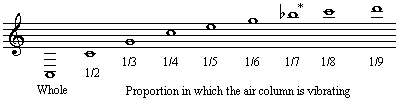

    The lowest note (the true fundamental) is not normally used by brass players because it sounds bad and is very difficult to play. The seventh partial (see asterisk in example above) sounds out of tune because it does not fit easily with the system of "equal temperament" now in common use. This is the reason trumpet players are taught to use the first valve instead (thus bringing into play a completely different harmonic series).

    It is simply not possible to have perfection in everything.
    Even so, no-one has yet been able to produce a practical wind instrument that was perfectly in tune with the "equal temperament" scale or any other tuning system. Only the trombone, with its adjustable slide, comes anywhere close. As Arthur Benade noted more than 30 years ago, every time an instrument manufacturer redesigns an instrument to improve dynamic range, intonation or ease of playing, the tone quality is altered [Arthur Benade "On the tone colour of Wind Instruments" in The Selmer Bandwagon, No. 59 (1970)]. A case in point is the Boehm flute. It is simply not possible to have perfection in everything.

    Some sort of reasonable balance needs to be struck. An important point to bear in mind is that different manufacturers seek different solutions, some of which may not be entirely satisfactory.

    Latest Video

    Category: BBJ
    Views: 24

    Category: BBJ
    Views: 6

    Category: BBJ
    Views: 1

    Category: BBJ
    Views: 0

    Category: BBJ
    Views: 1

    Category: BBJ
    Views: 2

    Category: BBJ
    Views: 1

    Category: BBJ
    Views: 5

    Category: BBJ
    Views: 1

    Category: BBJ
    Views: 4

    Category: BBJ
    Views: 7

    Category: BBJ
    Views: 7
    © 2026 Your Company. All Rights Reserved. Designed By JoomShaper

    Please publish modules in offcanvas position.